A 60-year-old doctor from Hyderabad saw an Instagram ad for a Char Dham helicopter package: six seats, three nights, VVIP darshan. He paid more than Rs 3 lakh. The emails that came back looked perfect, with tickets, hotel confirmations and darshan details. He found out only when he called the hotel to double-check. No booking existed.
The faith was real. Nothing else was.
Now the other half of the picture. A Dun & Bradstreet study put attendance at the 2025 Maha Kumbh at over 66 crore. Nobody ran a campaign to make those people come. Devotion is the one thing in this sector that needs no marketing. Everything between the devotee and the deity is where it breaks: the daily practice, the puja, the stay, the guide, the queue, the crowd, the price, the story of the temple, and proof that the person on the phone is who they say they are.
That gap is why I am building in spirituality and wellness this time, and why I do not call it a yatra business. A yatra happens once or twice a year. Devotion happens every day: a morning darshan, a festival date, a bhajan, a Gita verse, the story of a temple nobody wrote down, a puja for an occasion, a pandit for a ceremony, an hour of quiet that grows into a retreat. I am building the layer underneath all of it, for the whole spiritual life of a family: an economy that pays the people who serve devotees, trust that can be checked, and experiences designed for a person rather than a crowd.
The economy nobody counts
India’s temple economy is large and badly measured. The most-cited baseline, drawn from NSSO survey data, puts it at Rs 3.02 lakh crore, about 2.32% of GDP. State officials say Kashi received 12.96 crore visitors and Ayodhya 23.82 crore in the first half of 2025 alone. Reporting on the Ministry of Tourism notes that it keeps no specific count of pilgrim visits.
Try sizing the market and the problem shows up. Published estimates differ by more than forty times, depending on what each report counts.
- Coherent Market Insights: faith-based tourism, 2026, USD 1.57 billion
- Future Market Insights: faith-based tourism, 2026, USD 17.2 billion
- Industry report on differ.blog: religious and spiritual market, 2025, USD 64.4 billion
- IMARC: religious and spiritual market, 2025, USD 70.1 billion
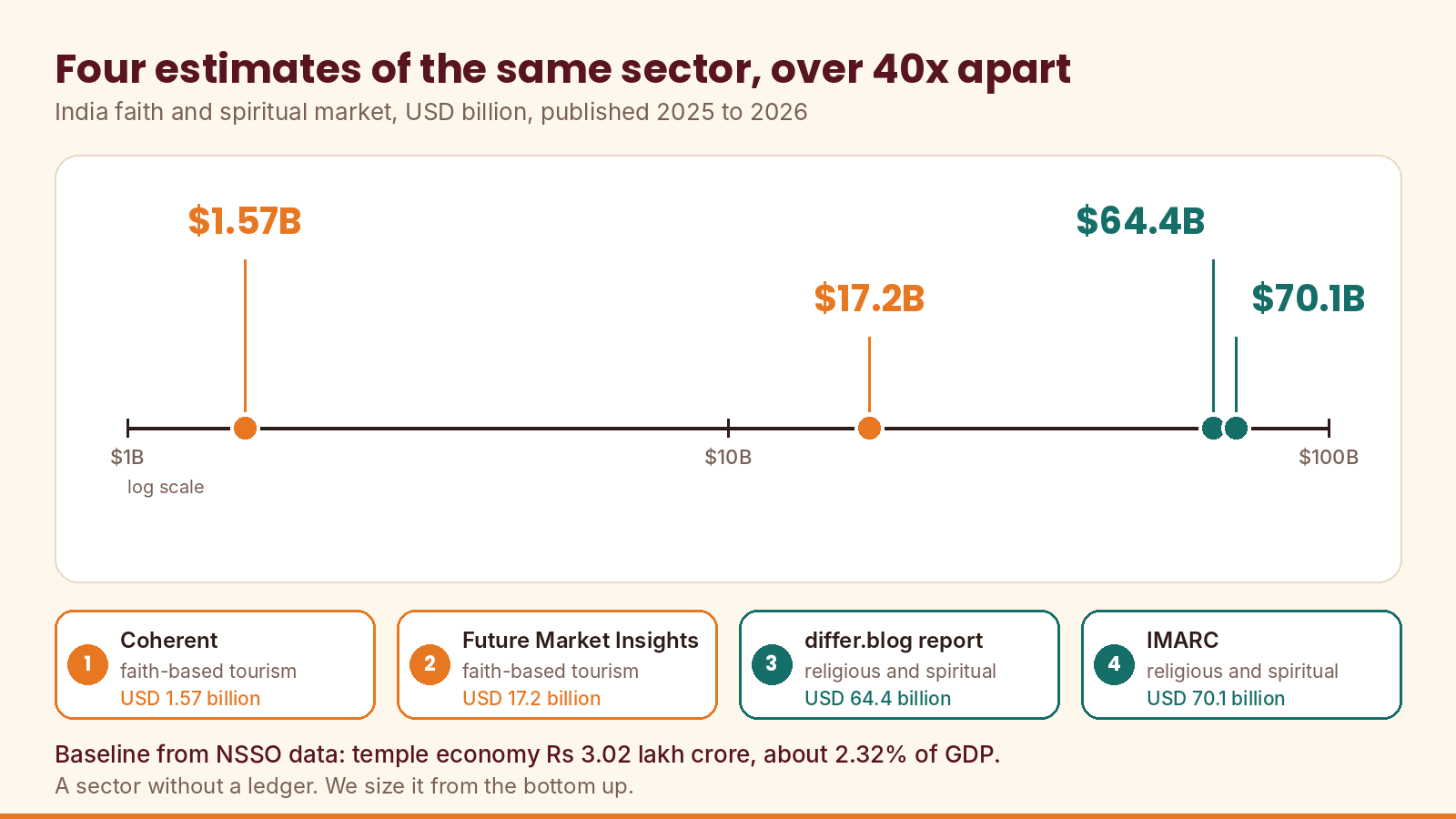
Definitions differ, so some gap is expected. A spread this wide still tells you something: this is a sector without a ledger. Nobody can say how many devotees booked a darshan last month, what they paid, or who they paid.
The people this economy is built on are the flower seller outside the Tirupati temple, the prasad maker in Varanasi, the homestay owner in Ayodhya, the priest’s family, the satvik cook, the artisan. Much of it still runs on phone numbers and word of mouth.
Three shifts changed who is travelling and why
The pilgrim got younger. Travellers aged 18 to 30 made up more than 53% of spiritual travel bookings in FY26, and 56% in Karnataka, according to travel-platform data reported in the press. In Rishikesh, about 59% of visitors are Gen Z. MakeMyTrip reported a 19% rise in accommodation bookings across 56 spiritual destinations in FY24-25, with 34 of them growing at double digits.
Spirituality and wellness are becoming one purchase. The KPMG-PHDCCI report released in June 2026, From Darshan to Destination, describes the move from short pilgrimage visits to experience-led journeys. India is the seventh-largest wellness economy in the world and grew 11.3% a year from 2019 to 2024, per Global Wellness Institute data. Within wellness tourism, digital detox is forecast to be the fastest-growing category at 17.33% a year through 2031, while yoga and meditation retreats hold the largest share at 41.24%.
Faith tech got funded, but mostly at the screen layer. AppsForBharat, the company behind Sri Mandir, raised Rs 175 crore in July 2025 and reports over 4 crore downloads, with 20 to 25% of demand from outside India. Its revenue splits roughly evenly between puja services and offerings, and its pooled puja model keeps about 25% of the amount. It also reported a net loss of Rs 45 crore in FY25, a reminder that this is not an easy category.
The money followed online puja, offerings and astrology. The physical layer is a different problem: an official-channel darshan, a verified stay, a guide who shows up at 4 am, a retreat run by people who know what they are doing, a story told by someone who knows the shrine. That layer still runs mostly on phone numbers.
What is broken, in public record
Fraud follows every pilgrimage season. In July 2026, Tirumala Tirupati Devasthanams warned devotees about a fake portal selling darshan and seva tickets and filed a police complaint. In Puri, police shut a website selling pujas at Rs 7,500 while the temple administration says darshan is free. The Trimbakeshwar trust went to the police over fake Kalsarp puja sites and apps. For Char Dham, Rudraprayag police blocked about 550 fake sites and accounts in May 2026, and the Home Ministry’s cyber-crime centre has issued a nationwide alert on fake helicopter, hotel and package bookings.
Crowds kill, and not only at the Kumbh. Six people died in a token queue at Tirupati on 8 January 2025. At the Prayagraj Maha Kumbh on 29 January, official tolls were in the range of 30 to 37, while a BBC Hindi investigation reported at least 82. Mansa Devi in Haridwar lost at least six people in July 2025, and nine died at a temple in Srikakulam in November 2025. Seven died at Ashok Dham in Lakhisarai in August 2026. The pattern repeats at the same kinds of places: ticket queues, narrow stairways and routes, transport hubs. KPMG and PHDCCI published a full report on this, Faith and Flow, in 2025.
Wellness quality is uneven. A recent Policy Circle commentary argues that India’s wellness industry needs evidence-based claims, better training standards and credible certification. A retreat that promises a cure and refuses to share its daily schedule is a warning sign for any buyer.
Heritage is fading in silence. For every famous temple there are many that few people can name, and their stories often live only with one priest’s family or one village elder. When that person is gone, so is the story. This is the loss no report counts.
And the critique that matters most to me. Some observers worry that putting worship on a phone breeds shallow, commodified engagement. I think that concern is fair. I also treat it as a design brief: technology should sit behind the experience, never in front of it.
Economy: seva that earns, and the hands that hold the temple town
A temple town is an enterprise economy, an employment economy and a tourism economy at once. It runs on hands: the hands that string the flowers at dawn, cook the satvik meal, open the homestay door, lead the guest to the ghat and chant the mantra at the ceremony. The question for a platform is simple: does the local person earn more because we exist?
That is the job of DharmikGuide, the partner network. It onboards verified pandits, astrologers, gurus, temple guides, drivers, photographers, yoga and meditation teachers, satvik kitchens, homestays, and craft and flower sellers. The same network serves more than travellers: a family in London sponsoring a puja back home, a household ordering prasad and sacred texts, a student learning the panchang from a scholar, a creator publishing a katha series. A verified profile, direct bookings and a visible name mean a guide or a pandit no longer depends on a middleman to be found.
The operating rule is written on our About page: grow alongside partners, not at their expense. In practice it means a reason for a guide to be at the ghat at 5 am. Seva that is paid fairly is seva that lasts.
Women first, by design. Our site says it plainly: women have always carried our living traditions. In most pilgrim towns the home is already the hospitality economy, and the woman of the house already runs it, often unpaid and unnamed. We focus on women-led stays and satvik kitchens, and on women who teach, craft and sell flowers, so that they earn with a verified profile, direct income and dignity, close to home. A guest who arrives expecting her food is the difference between seva that is taken for granted and seva that is a livelihood.
A new generation, on both sides of the counter. Gen Z is more than half of spiritual bookings. They are not looking for a lecture or a crowd. They want stillness, a practice, a story with roots and a community that does not judge them. So the ladder below starts with a Gita verse and a bhajan on the phone. The same generation is also our next set of partners: the yoga teacher, the storyteller, the photographer, the young guide who knows the lanes of her own town. I want a young person in a temple town to see that devotion can be a respectable career.
A home in the town. DharmikStays and DharmikHubs are the on-ground layer: verified hotels, ashrams, homestays, dharamshalas and retreat centres near the temple, and a physical presence in the temple town itself. An app is a door. A hub is a threshold, the place where a devotee, a partner and a story can meet. I will not describe what is not open yet. I will say what it is for.
One operating lesson shows why the economy is still offline. Roughly 40% of enquiries reached us outside a 10 to 6 office day, from families in other time zones or devotees who plan at night. We are moving to two shifts that cover 6 am to midnight. Nobody had to be convinced to want the yatra. They only needed someone to answer.
The larger target is 10 lakh local livelihoods over five years. That is a target, not a result.
Trust: make verification boring
I spent my last stretch building AI for insurance and healthcare. One lesson carried over: trust is created at the point of sale, not after it. Here the point of sale is a family planning a once-in-a-lifetime trip, often from another country. So trust is the product, and it is built from small, checkable rules.
- Official channels only. The darshan portal books through each temple’s own channels, such as paid seva queues, special-entry darshan, and helicopter and palki operators, and never bypasses temple rules.
- Prices that say how firm they are. On the wellness site, every journey is labelled as a firm price, a from-price or an indicative price. Where it is indicative, the page explains why: stay rates and temple seva fees for that location are not yet confirmed.
- Saying when we are the wrong choice. The leadership retreat page states plainly that if you need a strategy offsite, a hotel will serve you better and we will say so.
- Care that is staffed, not promised. At the Antar Yatra evening in Lucknow, a trained counsellor stays with the group the whole time and has no other duty. Health questions are asked privately after booking and never collected on the website. A fire keeper tends the sacred fire for the full hour with sand, water and an extinguisher within three metres, and anyone who wants a cab home gets one, grouped by area.
- Public standards for content. DharmikStudio publishes its content standards, a note on how AI is used, and a grievance page.
The honest position is that any brand that earns trust here will be impersonated. The defence is to make verification routine: official channels, itemised inclusions, and a person who answers on WhatsApp. For devotees the advice is the same whoever they book with: confirm the booking with the temple or operator directly before paying.
Experience: a ladder, not a funnel
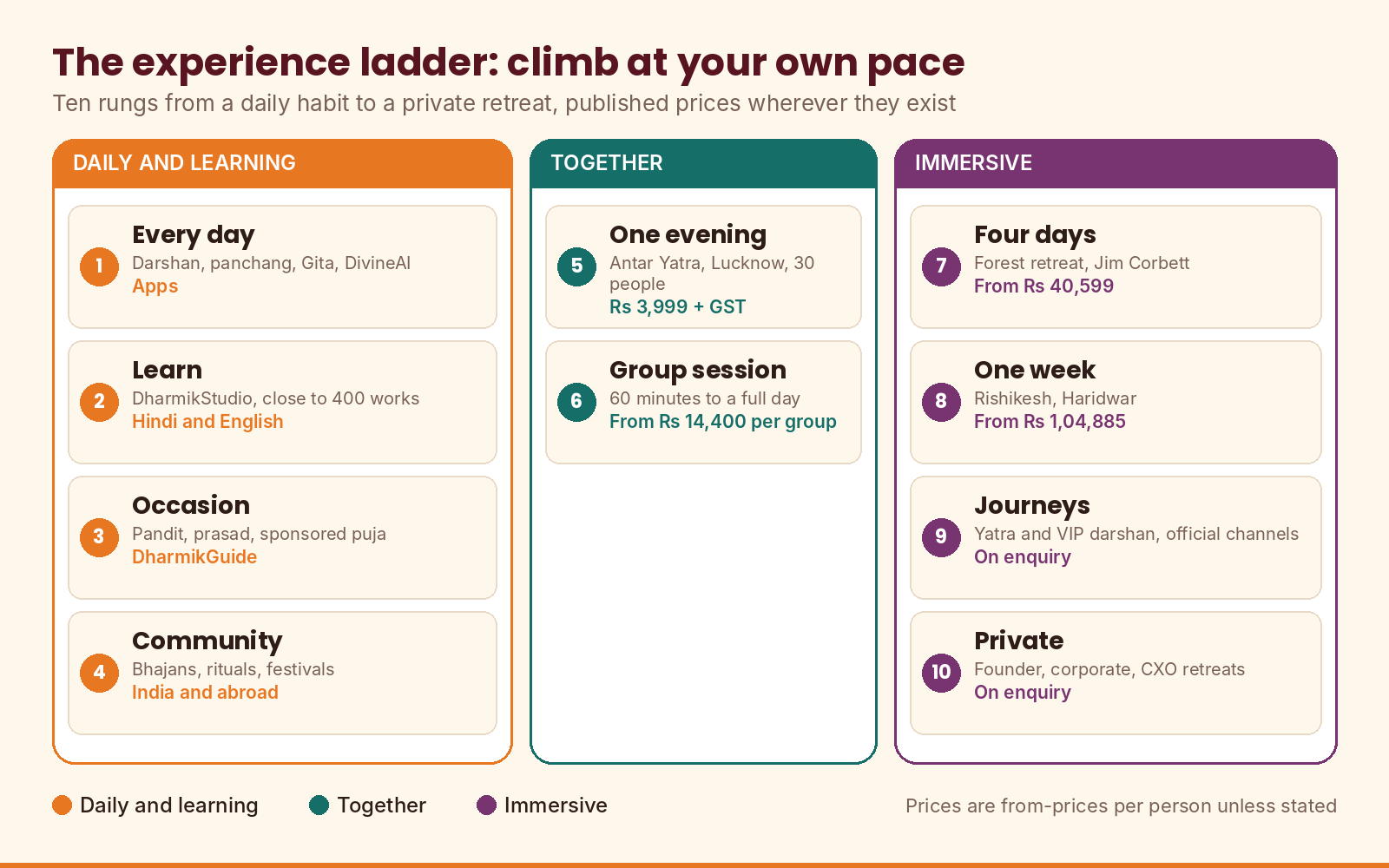
A young professional in Lucknow and a retired couple in New Jersey both want something spiritual, and neither wants a crowd. A yatra is the highest-value moment, but it is one rung. The experience layer runs from a daily habit to a private retreat, with a published price wherever one exists, so a person can climb at their own pace.
- Every day: daily darshan and ePuja online, a dharmik calendar and panchang for festivals and vrats, bhajans, Gita Sadhana (all 700 verses with gentle daily streaks) and DivineAI, a voice companion in your own language. Entry: apps on Google Play and the App Store.
- Learn: DharmikStudio, close to 400 works in Hindi and English. 257 of them are heritage and culture: 67 on temples, 66 on tirthas, 69 on living traditions, 36 state and region guides and 9 hidden stories. Alongside them sit 50 festival guides, puja vidhis, katha, the Gita and meditation.
- Occasion: a pandit or astrologer for a ceremony or consultation, prasad and sacred texts delivered home, a puja sponsored from abroad. Entry: DharmikGuide and the app.
- Community: bhajans sung together, live events, group rituals and festival gatherings, in India and abroad.
- One evening: Antar Yatra. Five hours of breathwork, sound and stillness for 30 people, ending with a fire release and a satvik dinner.
- Group session: a wellness layer for a yatra, or standalone, 60 minutes to a full day.
- Four days: Return to Yourself, a forest retreat in Jim Corbett for 12 to 15 people.
- One week: a residential retreat in Rishikesh or the Himalayan Ganga Sadhana journey in Haridwar and Rishikesh.
- Journeys: yatra and VIP darshan through official temple channels, with stay and travel.
Each rung has a reason to exist. The Founder’s Sankalpa Retreat, for example, studies the Gita’s teaching on acting fully while releasing the claim on the result. Phones are collected during sessions and the afternoons are deliberately empty, which the page says is the part founders find hardest and need most.
The daily and content layers are how people meet us before they spend anything. A yatra is bought a few times in a lifetime. A daily practice is where the relationship, and the trust, gets built. The bet is that a family that reads our Dev Uthani guide in November, or opens a Gita verse each morning, is the family that asks us about Kashi in February.
On the other side of the phone, DivineAI is a voice-first companion built so a devotee can plan a yatra, ask a question or arrange a darshan by simply talking, in their own language. The technology goes behind the experience, which is where I want it.
The India that is not on the map
Every tirtha has one famous temple and ten that no guidebook mentions. There is an Ulta Hanuman Mandir in Sanwer. There is the Rahila Sagar Sun Temple in Mahoba, which our own studio calls a forgotten radiance of Surya. There is the Vaduvur Sri Ramar temple, which devotees call Dakshina Ayodhya, the Ayodhya of the south. Each one holds a katha, a custom and a family of priests who keep the lamp lit. Most of it lives in memory, and memory is the most fragile archive we have.
This is the part of the work I feel most tenderly about. Heritage is not only what stands in stone. It is the grandmother’s vrat katha, the village bhajan mandali, the festival custom that changes from one river bank to the next. DharmikStudio has begun with 9 hidden stories and 69 traditions. That is a small beginning, and I would rather say so. The method is the point: record with permission, credit the keeper, publish in Hindi and in English, and treat the storyteller as one more local livelihood that deserves to be paid.
This is also where the ladder begins to climb. A person reads a story about a shrine they never knew. A month later they want to stand in front of it. They need a verified guide, a clean place to stay, a pandit who will do the ritual properly. The unknown becomes known, and the town earns from the visit.
The circle is wider than one faith.
Ritual and community: what keeps a practice alive
Ritual is the one thing no screen can replace, and the one thing a careful platform can protect: the right pandit, the right vidhi, the right sankalp, the prasad that actually reaches home. Community is what keeps a practice alive when enthusiasm fades. A bhajan sung with strangers, a festival kept together, a puja sponsored from London for a family in Ujjain. 65% of our first-year devotees were NRI, and for many of them a community and a hub are how a distant home stays near.
So the ecosystem is not a list of products. It is a circle. The story invites, the daily practice keeps, the ritual consecrates, the community holds, and the local family that served the devotee is blessed in return.
Why this time
In insurance, the customer rarely wakes up wanting the product. You create the want, then earn the trust, then deliver. Here the want already exists. Crores of people travel for it every year without being asked. What is missing is trust and delivery, and those are problems where software and careful verification can do real work.
There is a second reason, and it is quieter. The traditions already contain the wellness practice. Kartik, the month we are in, is a seasonal routine of fasting, lamp-lighting, early rising and satvik food. A 25-year-old looking for calm and a grandmother keeping a vrat are doing similar things for similar reasons. The market is catching up with something the culture never separated.
So I do not think of this as a yatra business, a wellness business or a devotional app. I think of it as three layers that have to work together:
- Economy. Verified local partners, women and the young among them, earn directly, so the temple town gets richer because the devotee came.
- Trust. Official channels, honest prices and staffed care, so a family can say yes without fear.
- Experience. A ladder from a daily habit to a private retreat, with heritage, ritual and community along the way, so devotion and wellness grow at the person’s pace.
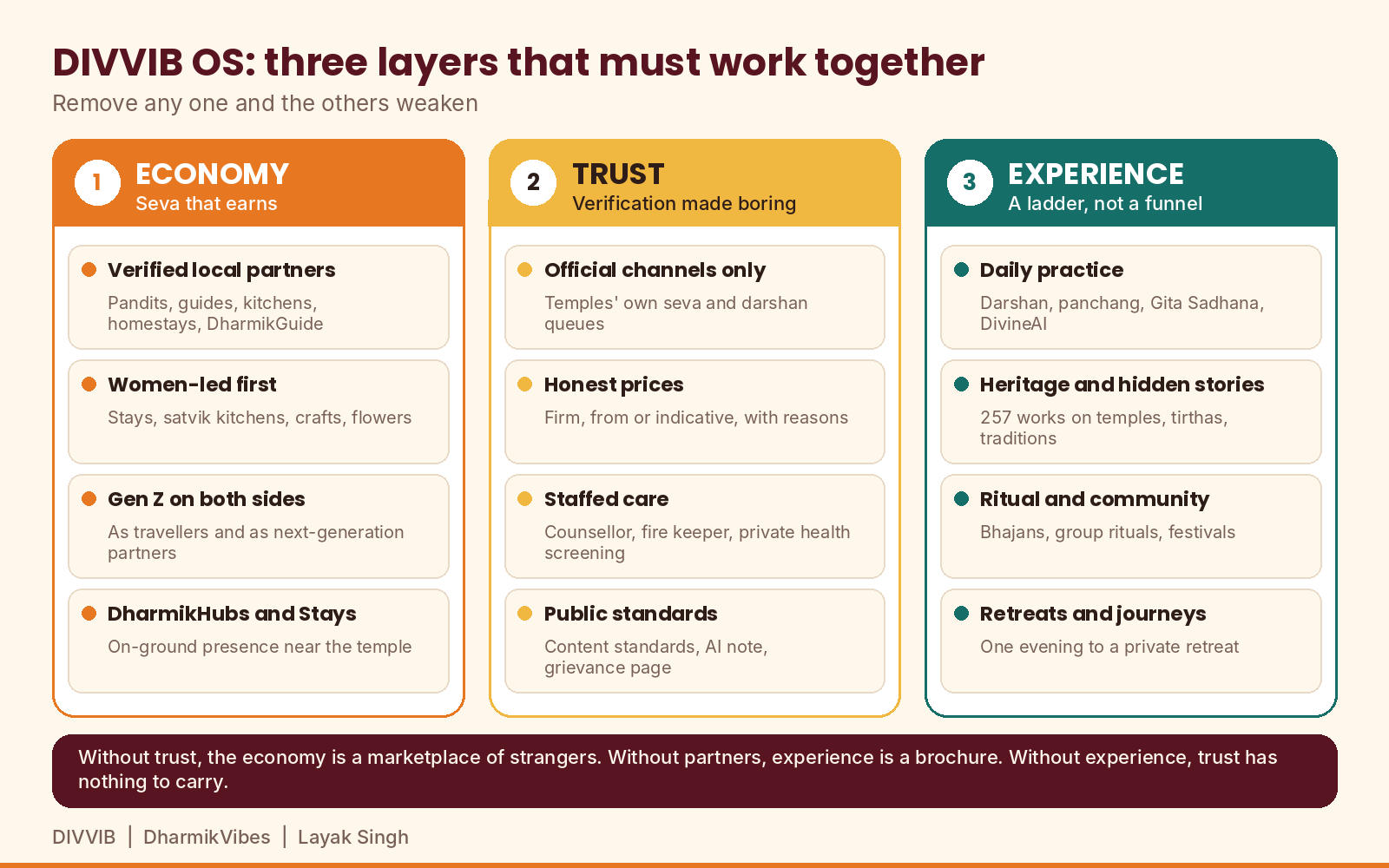
Remove any one and the others weaken. Without trust, the economy is a marketplace of strangers. Without local partners, the experience is a brochure. Without experience, trust has nothing to carry.
Where this goes
The doctor in Hyderabad needed one thing: a way to know. Know that the helicopter exists, that the hotel has his name, that the person on the phone is real. Most of what I am building is an answer to that single need, repeated in every temple town and for every family that travels for faith.
If you run a temple trust, a homestay, a kitchen or a guide service, you are the economy this is built for. If you teach yoga, practise Ayurveda, keep a local story or create devotional content, there is a place for you in the experience layer.
॥ सर्वे भवन्तु सुखिनः ॥ May all be well.
dharmikvibes.com | divvib.com | wellness.dharmikvibes.com | studio.dharmikvibes.com | blog.dharmikvibes.com
Also published on LinkedIn, in The Entrepreneur’s Mind.